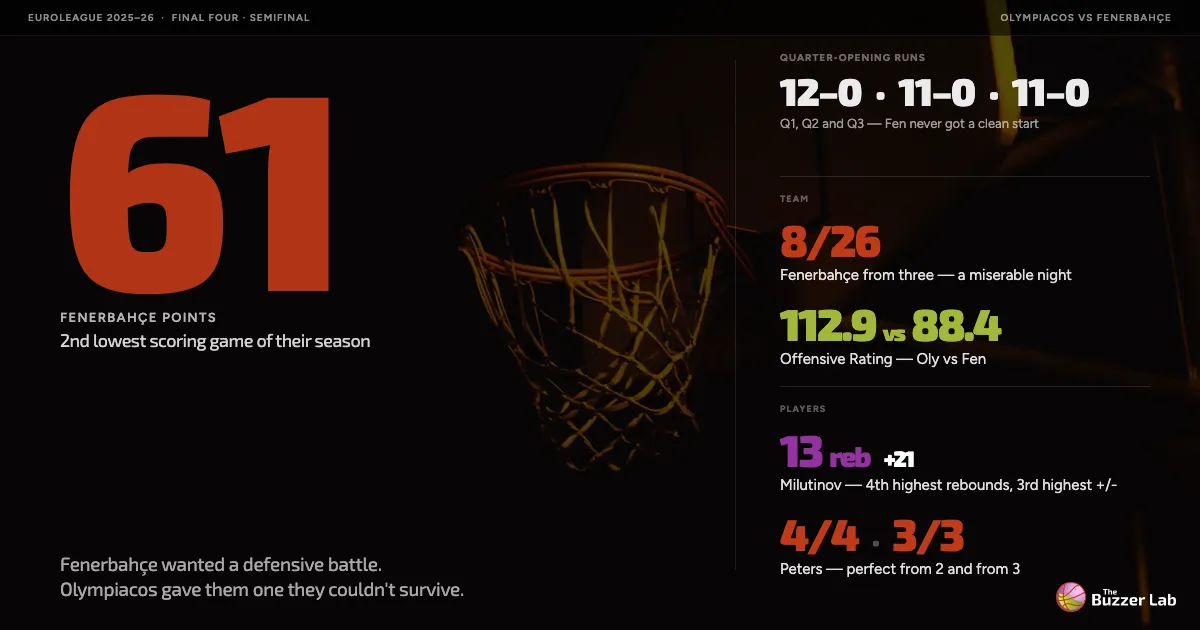
Georgios Bartzokas has taken Olympiacos to five straight Final Fours, and last season he finally won it. Right now there isn't a better coach in Europe. What makes him interesting, though, isn't the trophies, it's the way his teams play. It even has a name now: Bartzokas-ball.
Everyone touches the ball
The core idea is easy to say and hard to do. Bartzokas wants the advantage created before anyone shoots. He just doesn't want a player, even his best one, to get the ball and make something happen. Instead he wants constant movement. So five players move, screen, cut and swap places until the defence is totally perplexed or forced into a mistake.
That's why Olympiacos can look almost choreographed. The ball swings, a man cuts, a screener becomes the next screener, someone arrives from the weak side, and the shot Bartzokas wanted is suddenly open. The opponent isn't asked to stop one player. They have to guard everything at the same time.
But it isn't chaos
Movement without order is just running around but Bartzokas-ball means strict structure: spacing rules, clear roles, a hierarchy everyone accepts. Everyone touches the ball, but not everyone has the same job, and the players know the difference.
This is why Olympiacos have so often overachieved. Bartzokas has reached the Final Four with rosters that, on paper, were cheaper than their rivals'. The system does part of the work. It gives a role player a clear job, the job gives him confidence, and inside that role he plays free.
He doesn't want robots
You'd expect a system this detailed to come from a control freak. Bartzokas is the opposite. He has openly said he doesn't want to overcoach his players or turn them into pawns. The structure is his. The decisions are theirs.
That's why his basketball needs intelligent players. Sasha Vezenkov is the perfect fit: he reads space, moves early, and never waits for a possession to be handed to him. And it's why, last season, Bartzokas dared to change — easing off the tension a little, trusting the natural talent in front of him a little more. It worked. He won.
Players feel the difference. Evan Fournier, back in Europe after years in the NBA, called him a "mastermind": "The way he thinks about the game is exceptional. He's team-oriented, which is a big difference from my experience in New York, where the game was much more about isolation."
Defence: discipline, not fireworks
The defence is the mirror image of the offence. No gambling for steals, no chaos. Just collective discipline: positioning, rotations, help, closeouts, and knowing exactly what the other team wants to do before they do it. And he adjusts. He isn't married to his first plan; he'll change the scheme mid-game when it isn't working. The aggression is real, but there's almost always a reason behind it.
The man on the sideline
Watch him for one game and you'd never guess how calm he is away from it. On the bench he lives every possession — pacing, arguing, visibly furious at a lazy closeout. He's deeply, almost helplessly attached to Olympiacos, a fan as much as a coach, happy to argue with rival supporters over his club.
Off the court he's a different man: calm, rational, sensitive. Even his angriest post-game words are usually about basketball, not blame — a bad read, a poor shot, the specific thing that went wrong. He can be harsh. He's almost always talking about the game.
That's the contradiction that makes him fascinating. The team looks controlled while the man coaching it looks anything but.
Bartzokas-ball, in one sentence
Create the advantage through movement. Give players freedom inside the structure. Make the opponent solve five problems instead of one. ANd evolve, never stop evolving.
Underneath it is a belief that the best way to make a player better is to put him inside a very good team, not to build the team around him. That's why Olympiacos have an identity that doesn't change with whoever is hot that month. And it's why, right now, nobody in Europe is doing it better.