Practice ends and the players stay on the floor to shoot. Saras Jasikevicius sits down with the computer.
Marko Guduric, who played four seasons for him, has described the routine: preparation for a single game spread over two or three days, basketball on the screen all day long, and an A4 notebook carried everywhere, filled with very small handwriting, one page for every game.
That is the whole man, more or less. Coach Saras is utterly focused. He neglects nothing.
Structure first, freedom after
His teams are organised to a degree that can look excessive from outside. Spacing, timing, the angle of a screen, where your feet are when the ball arrives. Players are expected to know not just the play but the second and third option inside it, because the first one usually disappears.
The point of all that movement is to make the defence commit to something. A player touches the paint, gives the ball up and relocates, and the next man receives it with information that did not exist a second earlier.
Which is why Jasikevicius can be uncomfortable for a player who trusts his instinct. He does not like a shot that exists only because somebody felt good about it. There has to be a reason.
The reason is often a number
Guduric told the story best. Jasikevicius showed him his own numbers: going left he produced 1.2 points per possession, going right 0.7. Then he told him he was one of the best in the league at going left.
One could thought we're talking about a coach flexing. Nope, coach Jasikevicius uses a number to give an instruction a player will actually believe. He comes from the old European school of detail, and he has absorbed the modern one without letting go of the first.
Guduric has also described how the offence is timed rather than just run: attacking inside the first eight seconds, or deliberately building the possession towards its last ones. Defensive concentration is not constant for twenty-four seconds. He attacks the gaps in it.
Defence is a set of rules
The same mind runs the other end. His teams are built on athleticism but he knows well this is not enough. As a result he wants everybody making the same decision every time: force the man to his weaker hand, hold your position after a switch, take away what the opponent wants most and live with what is left.
A mistake in his defence is rarely about effort. It is about breaking a rule.
That is what made Fenerbahce so hard to play. Five men doing ordinary things in the same order, again and again, especially once a game turns chaotic.
He has changed twice
At Zalgiris, where he became head coach in 2016, he scripted almost everything. The budget was small and the margin came from organisation. It worked: four Lithuanian titles, and in 2018 a Final Four, the club's first since 1999.
Barcelona, from 2020, was a different room. More money, more established players, more opinions. He reached the final in his first season and lost it to Anadolu Efes.
At Fenerbahce he loosened his hands. He still wants control, but he now looks for it through principles rather than instructions, and his guards are allowed to read the game instead of waiting to be told. In 2025 he won the EuroLeague, and became the first man in the modern competition to win it as a player and as a coach. He had won four as a player.
He talks about this himself. Asked about coaches he admires, he points to the ones who kept changing over decades, Zeljko Obradovic among them, rather than the ones who found a method and defended it.
The man on the bench
None of this makes him calm. He argues, he shouts, he holds his head, he treats a bad possession in October like a personal insult. He is blunt in press conferences and often funny, and he does not deal in the usual coaching language.
The clearest picture of him came at Zalgiris, when Augusto Lima left a playoff semi-final to be at the birth of his child. A reporter kept asking why he had allowed it. His answer: when you see your first child, you will understand what the most important thing in life is, because nothing in the world can be more majestic than the birth of a child. Not titles. Not anything else.
Where he is now
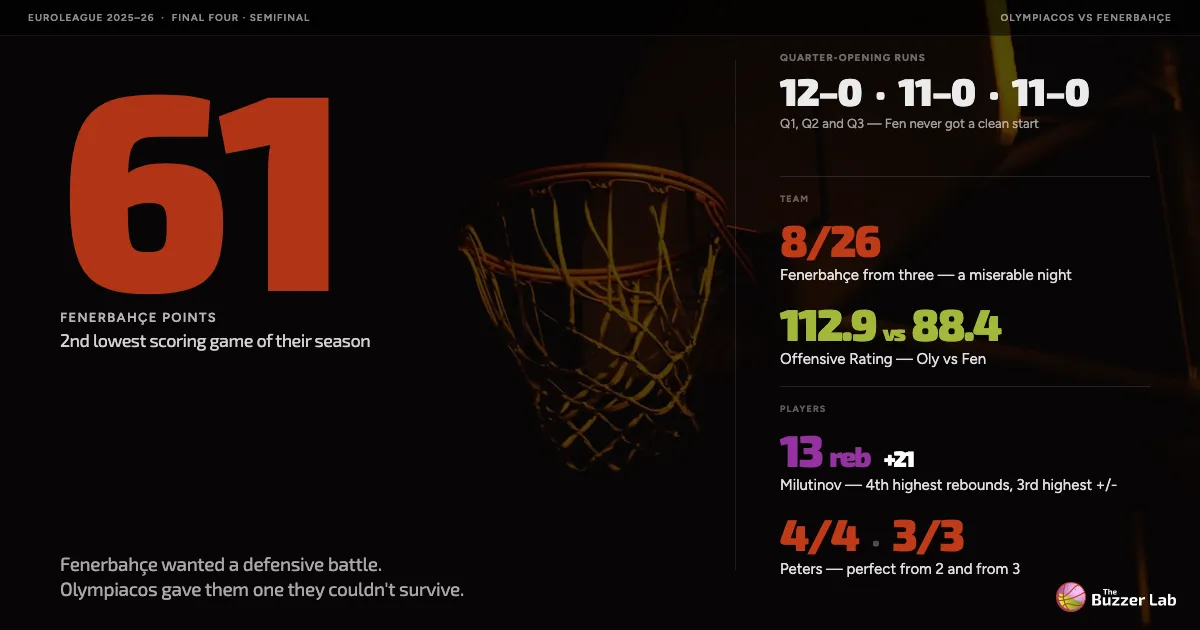
Last May, as defending champions, his team met Olympiacos in the Athens semi-final and scored 61 points. The defence held up. The offence never arrived.
This summer Fenerbahce signed Shane Larkin from their rivals across the city, which gives Jasikevicius the one thing his system has sometimes lacked: a guard who can settle a possession when the plan runs out.
As a player he controlled four men for twenty-four seconds at a time. As a coach he is trying to build something that does not need him to.