Win-loss records tell you who's winning. They don't tell you how. Two teams can have similar records for completely different reasons — one scoring a lot and giving up a lot, another grinding out close games on defense. Offensive Rating and Defensive Rating separate those two stories.
The basics
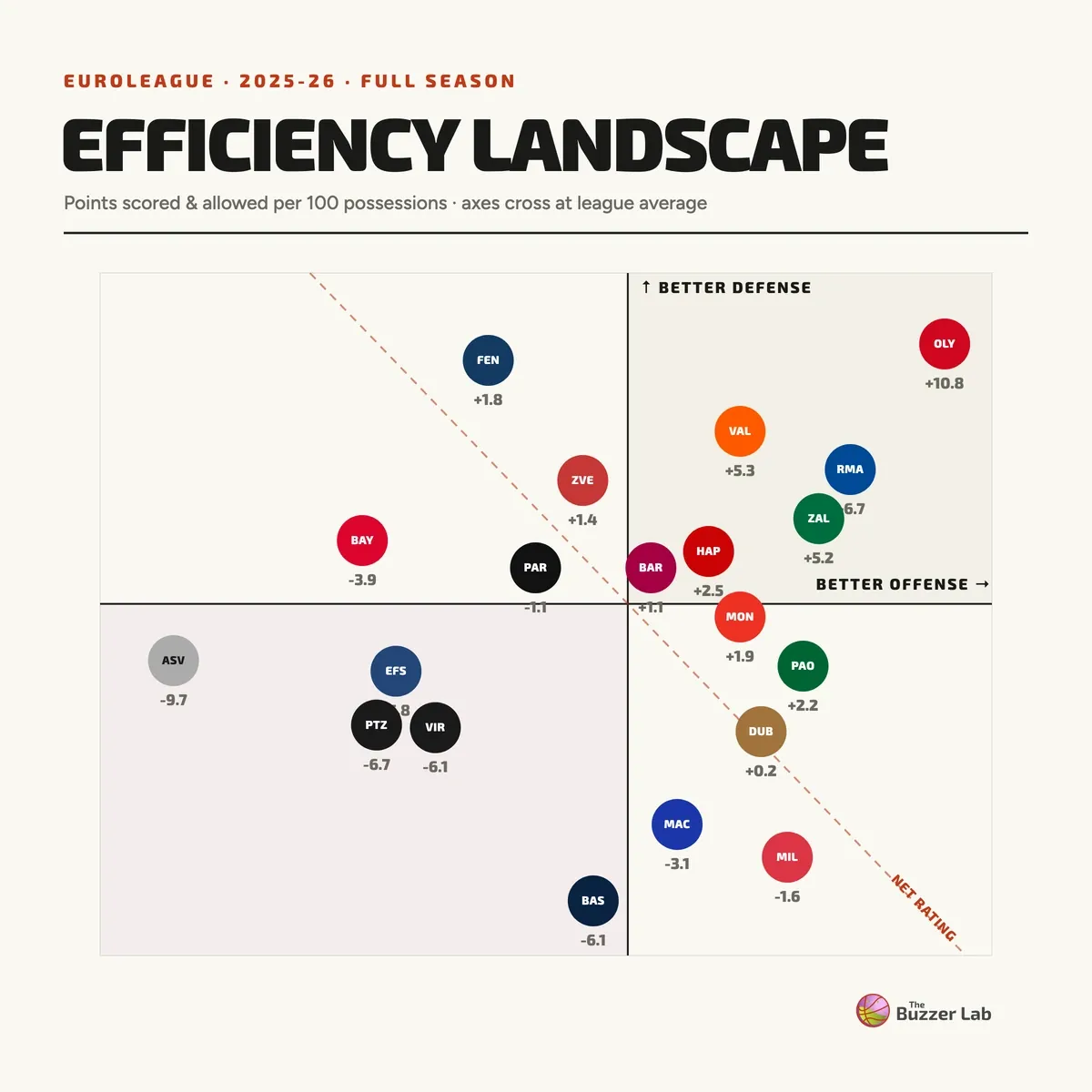
Offensive Rating measures points scored per 100 possessions. Defensive Rating measures points allowed per 100 possessions. Net Rating is simply the difference between the two — how many more points a team scores than it allows, adjusted for pace. It's the clearest single number for how good a team actually is, because it strips away the noise of fast or slow games and just asks: per 100 trips down the floor, are you ahead or behind?
Olympiacos stands alone
At +10.8 net rating, Olympiacos isn't just the best team on this chart — they're in a different tier entirely. The next closest team, Real Madrid, sits at +6.7. That four-point gap between first and second is significant in efficiency terms. Being good at one end of the floor is normal. Being elite at both, the way Olympiacos are, is genuinely rare — most teams that dominate offensively give something back on defense, and vice versa. Olympiacos don't.
Why defense-first teams stall
The hardest position on this chart isn't being bad at everything. It's being good at defense and stuck on offense — the profile shared by teams like Fenerbahçe, Crvena zvezda, Paris and Bayern. Defensive quality is usually built on system and discipline, things that transfer game to game regardless of who's on the floor. Offense is more fragile — it depends on shooting nights, on specific matchups, on whether your creators are healthy. A team can drill defensive rotations into muscle memory. Nobody can drill a jump shot into going in. That's why defense-first teams often stay stuck exactly where they are: the fix isn't a system change, it's finding shot-makers, and that's a harder problem to solve mid-season.
Why offense-only teams are more fixable
The opposite profile — Panathinaikos, Dubai, Milan, Maccabi — tends to be the more correctable one. A team that can already score just needs to tighten its defensive coverages, and defensive schemes can improve within a single season through coaching adjustments in a way that shooting rarely does. It's not a coincidence that teams with a positive offense and negative defense often trend upward as a season progresses, once a coaching staff commits to fixing rotations and closeouts.
The cost of being behind on both
At the bottom of the chart, ASVEL's −9.7 is the most extreme number in either direction — worse than Olympiacos's advantage. Efes, Partizan, Virtus and Baskonia all sit in similarly difficult territory. Being below average on both ends is the hardest place to climb out of, because there's no single lever to pull. Fix the defense and the offense is still a problem. Fix the offense and the defense still leaks. It typically takes more than one transfer window to move a team out of this quadrant.
What the chart really shows
Most teams are lopsided, not balanced. Strong on one end, weak on the other is the normal shape of a EuroLeague roster. That's exactly why Olympiacos's position matters — not because their number is highest, but because that combination of two strengths at once is the hardest thing in the league to build.
You can check where your own team sits, and see the full ratings breakdown, in the Teams section.