Sasha Vezenkov plays like Dario Saric. The tool puts the resemblance at 82%, with Jordan Nwora at the same number and Zach LeDay a point behind.
That is the sort of answer Who Plays Like exists to give. Pick any player in the EuroLeague, and it finds the players whose game is shaped most like his.
How it decides
Every player is reduced to six dimensions: scoring, shooting, size, rebounding, disruption and passing. Each one is measured per 36 minutes and scored against the whole league, so a reserve who does something at a high rate is not punished for playing fewer minutes.
Then there is a seventh term, and it is the one that makes the results usable: how central the player is to his team. Without it, a bench big who rebounds hard for twelve minutes comes out looking like Nikola Milutinov. With it, stars match stars and role players match role players.
Similarity comes back as a percentage. Vezenkov to Saric is 82%. Milutinov's closest match in the league is 72%, which tells you something on its own: the further down the percentages go, the rarer the player.
Here is the whole thing on one screen. Mathias Lessort's closest match in the league is Dan Oturu at 83%, and the panel on the right says where that comes from: most alike in disruption and rebounding, furthest apart on passing and scoring. Lessort's rebounding sits in the 95th percentile of the league, Oturu's in the 96th. On passing it is 44 against 9.
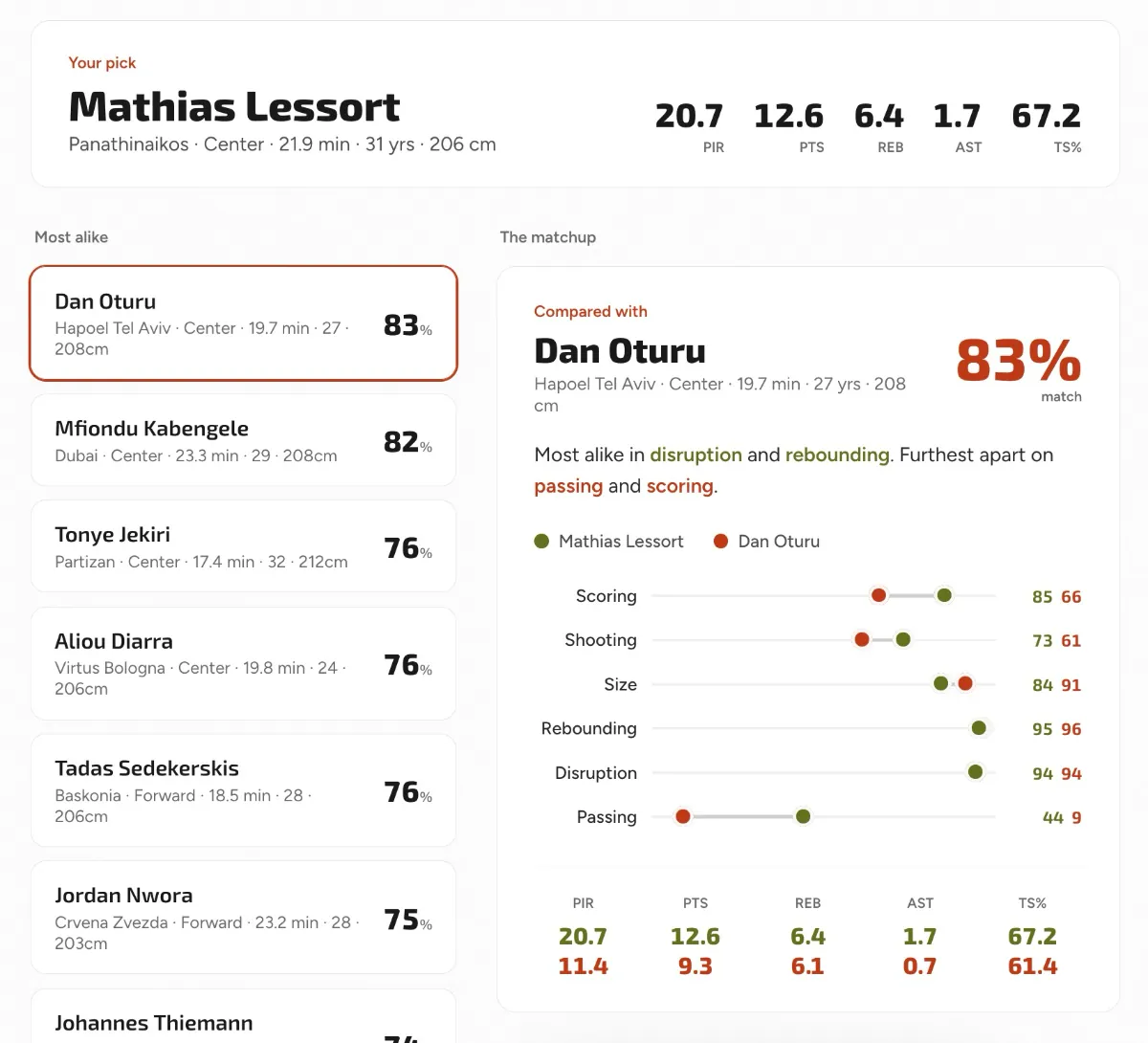
That last line is the point of the tool. Two centres who rebound and protect the rim almost identically, and one of them passes and the other does not.
Choose what "alike" means
This is the part that separates it from a list somebody else wrote.
The default is Overall, every dimension at once. But you can pick a single angle and the tool will only show players who genuinely share that trait before ranking them: Scoring, Shooting, Size, Rebounding, Disruption or Passing. Ask who shoots like your man and you get shooters, not players who happen to score the same amount by other means.
Two switches sit next to it. Same position only, for when you want a direct replacement rather than a stylistic cousin. And Sleepers, which keeps only players aged 23 and under, which is how you turn a comparison tool into a scouting one.
What it will not tell you
It reads style, not quality. A worse player can look 80% like a better one, because they do the same things in the same proportions and one of them does them well. The matchup panel puts both sets of numbers side by side and leaves the judgement to you.
Defence is the usual honest gap. The box score sees steals and blocks and nothing else, so Disruption is a sliver of real defence rather than a measure of it. A great positional defender does not show up here.
Who Plays Like joins the Premium shelf, next to Head to Head, Player Impact and Season Phases. That is where the tools go when they stop answering what happened and start answering why, and it is the reason the subscription exists: a season's worth of questions you cannot ask anywhere else.
The worked example on the page is open to everyone, so you can see exactly what you would be getting. Then go and start with the player you argue about most.