Ten games into the season, 57 players are averaging ten points or more. The scoring table ranks them against each other and tells you nothing about the only question a coach actually has, which is what this man will give me tonight.
Two players can hold the same average and be nothing alike. One arrives with eleven points nearly every time. The other gives you two, then eighteen, then two again.
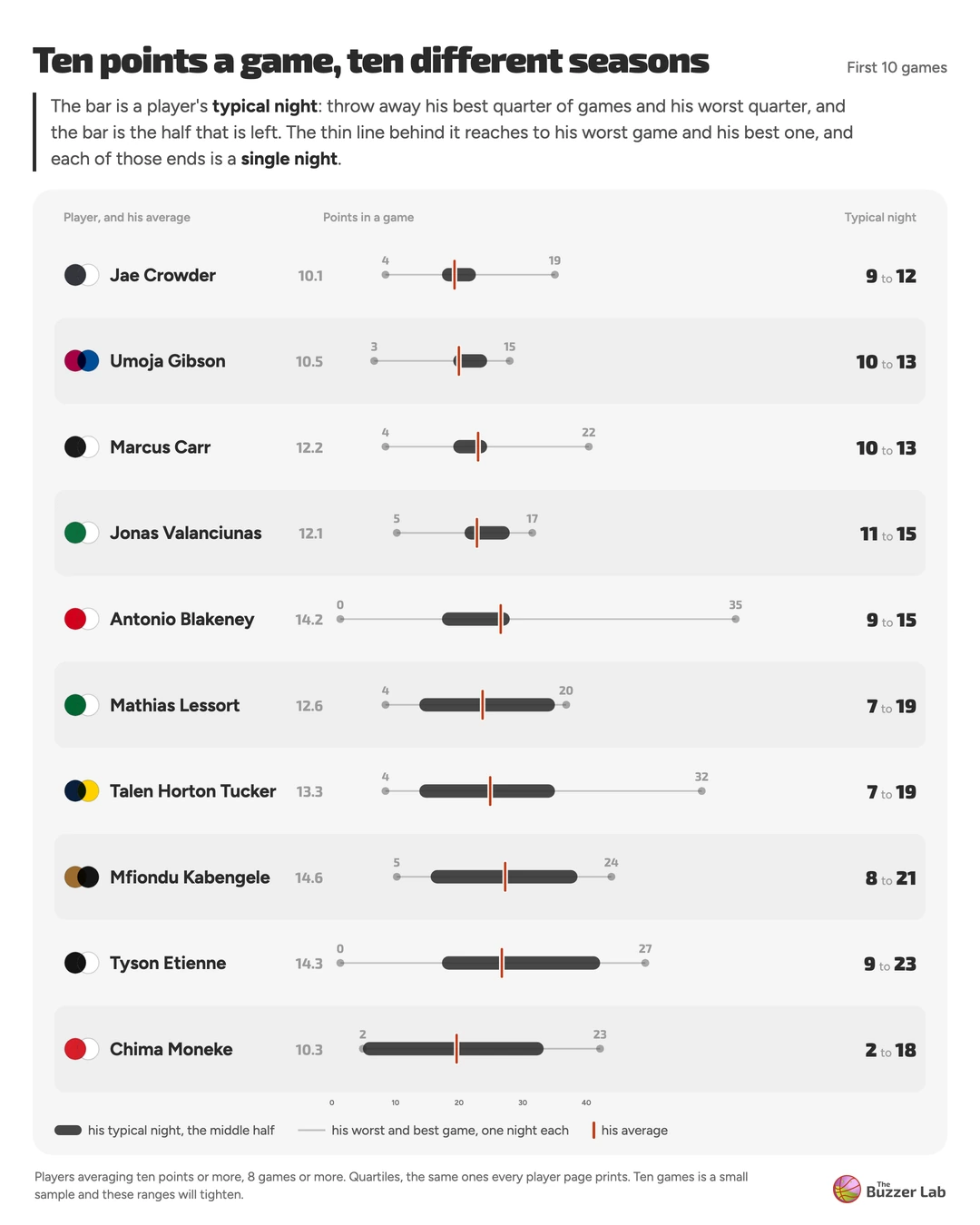
There is a simple way to see which is which, and it is already on every player page here. Take a player's games, throw away the quarter where he scored most and the quarter where he scored least, and look at the half that is left. That is his typical night. It is a range, not a number, and the width of it is the whole story.
The two ends of the league
All figures below are the first ten games of this season, for players averaging ten points or more.
The narrowest typical nights in the league:
| Player | Average | Typical night | Gap |
|---|---|---|---|
| Jae Crowder | 10.1 | 9 to 12 | 3 |
| Umoja Gibson | 10.5 | 10 to 13 | 3 |
| Marcus Carr | 12.2 | 10 to 13 | 3 |
| Wendell Moore | 12.0 | 11 to 14 | 3 |
| Dario Saric | 11.4 | 10 to 14 | 4 |
| Jonas Valanciunas | 12.1 | 11 to 15 | 4 |
And the widest:
| Player | Average | Typical night | Gap |
|---|---|---|---|
| Chima Moneke | 10.3 | 2 to 18 | 16 |
| Tyson Etienne | 14.3 | 9 to 23 | 14 |
| Mfiondu Kabengele | 14.6 | 8 to 21 | 13 |
| Carlik Jones | 13.8 | 7 to 20 | 13 |
| Mathias Lessort | 12.6 | 7 to 19 | 12 |
| Talen Horton-Tucker | 13.3 | 7 to 19 | 12 |
Crowder and Moneke average within a fifth of a point of each other and sit at opposite ends of the same list. Carr and Jones are a point and a half apart on average, and one of them has a typical range four times wider than the other.
The wide ones are not missing more
The obvious explanation for a streaky scorer is that his shooting comes and goes. For most of these men it does not.
Moneke shoots 65.2% True Shooting, which measures scoring efficiency with threes and free throws counted at their real worth. That is an excellent figure. What changes from night to night is not whether the shots drop. It is whether he takes any.
In his three two-point games he attempted two shots, then one, then five. In his two eighteen-point games he attempted twelve. He is not cold on the quiet nights. He is absent from the offence, and only one of those is a shooting problem.
Lessort and Kabengele are on the wide list for a related reason. Both are having unusual seasons, as last week's piece on centres set out, and a player whose role is still moving swings more than one whose role has settled.
Check the minutes before calling anyone streaky
The widest single range in the league belongs to Antonio Blakeney, who has scored 0 and has scored 35.
The 0 came in seven minutes.
Take out that one short night and his season reads 7 to 35, with a typical night of 9 to 15, which is narrower than half this list. He is an ordinary scorer who occasionally goes off, and the number that made him look wild was a game he barely played. On the chart his row is the clearest case of the shape: a long thin line with a short bar sitting inside it.
Moneke's quiet games came in sixteen, nineteen and twenty-one minutes. He was on the floor for all of them. That is the difference between a swing that means something and one that does not, and the minutes column is the only way to separate them.
What it is for
An average answers a question nobody asks. Nobody wants to know what a player did across ten nights flattened into one. They want to know what he is likely to do tonight.
The typical night answers that, and it is two numbers instead of one. Both sit on every player page here, under the season stats, and they are worth more than the average above them.
Ten games is a small sample. These ranges will narrow as the season runs and the order will change. The difference between the two kinds of scorer will not.