Mathias Lessort produces half as much again as he did a year ago, and he plays the same minutes.
His PIR has gone from 13.5 to 20.8. PIR is EuroLeague's all-in-one rating: it adds up everything a player does well, then subtracts the misses, the turnovers and the fouls. His minutes went from 22.2 to 23.4, which is nothing.
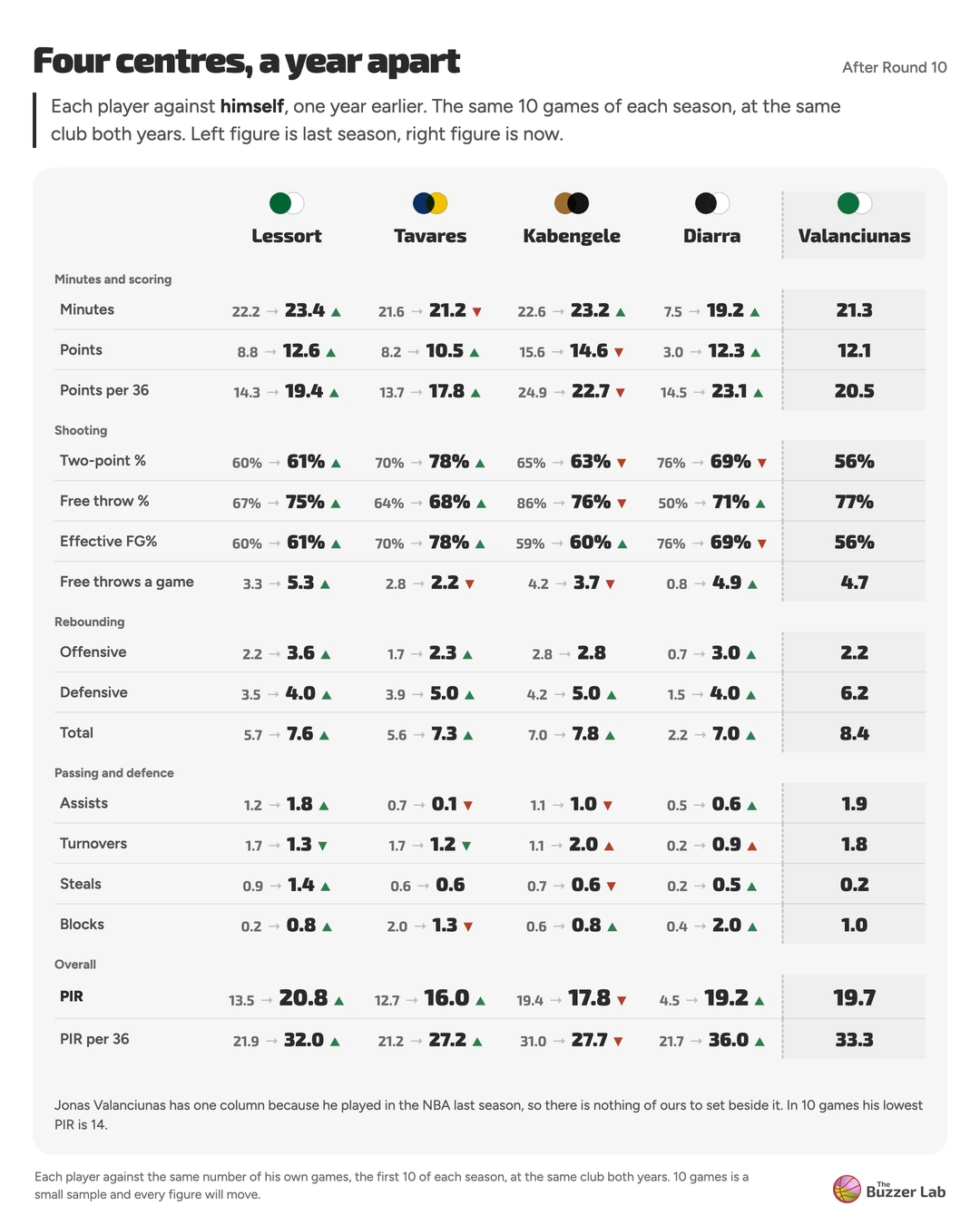
Four of the best centres in the league have played ten games this season. Here is each of them against his own first ten games of last season, at the same club both years. They have moved in four directions, and no two for the same reason.
Lessort gets to the line now
Nothing happened to his shooting. Lessort made 60.0% of his two-point shots a year ago and makes 60.6% now. He has not attempted a three all season, so that is his whole shooting profile, and it is the same profile.
What changed is how often he is fouled. His Free Throw Rate, which is free throws earned per shot taken, went from 60.0 to 74.6. In plain numbers he takes 5.3 free throws a game where he took 3.3, and he makes 75.5% of them against 66.7% last year. That is two extra trips a night, and he misses fewer of them than he used to.
Around it, the small things all moved the same way. Offensive rebounds 2.2 to 3.6. Blocks 0.2 to 0.8. Turnovers 1.7 down to 1.3.
Panathinaikos are top of the table at 8-2.
Tavares is 34 and finishing better than he ever has
Walter Tavares went the other way to Lessort. He takes fewer free throws, not more.
His Free Throw Rate fell from 60.9 to 37.9. What rose is what he does with the shots he keeps: 69.6% on two-pointers last season, 77.6% this one. His rebounds went from 5.6 to 7.3 a game in slightly fewer minutes. PIR 12.7 to 16.0.
There is a cost in there, and it is worth saying. His blocks are down from 2.0 a game to 1.3. For a man whose defence is the reason Real Madrid play him, that is the number to watch, more than the shooting.
Kabengele is the one going backwards
A year ago Mfiondu Kabengele was the best of these four. His PIR over the first ten games was 19.4, higher than anything Lessort or Tavares reached. This season, in the same 23 minutes, it is 17.8.
His shooting is fine. His Effective FG%, which is shooting accuracy with a made three worth more than a two, is 60.2% against 59.4% last year. He is the only one of these four who takes threes at all.
Two things are. He turns the ball over 2.0 times a game against 1.1, so he has nearly doubled the giveaways in the same minutes. And his free-throw shooting fell from 85.7% to 75.7%, which for a centre who earns almost four a game is a point a night on its own.
Dubai are 7-3 and sixth, so nobody is alarmed. The decline is quiet and it is real.
Diarra plays more, and is better per minute as well
Aliou Diarra has the largest jump of anyone here, from 4.5 PIR to 19.2, and most people would stop there. Stopping there would be wrong, because his minutes went from 7.5 a game to 19.2. More minutes means more PIR whatever a player does, PIR counts things up, so the total grows with the court time.
So the honest test is per 36 minutes. On that scale he went from 21.7 to 36.0, the highest of the four. He got more minutes and he got better in them.
The engine is defence and second chances. Blocks 0.4 to 2.0 a game. Offensive rebounds 0.7 to 3.0. Free throws earned, 0.8 attempts to 4.9.
One number went down. He shot 76.5% on twos last season and 68.8% now, because last season he took 1.7 shots a game and this season he takes 6.4. A man who only dunks shoots a high percentage. Virtus now ask him to do more than dunk.
The best centre here cannot be in this article
Jonas Valanciunas is second among centres on PIR at 19.7, behind Lessort and ahead of everyone else in this piece. He is not in it, because he played in the NBA last season and we only use numbers we compute ourselves.
What we can say about him stands on its own. In ten games his lowest PIR is 14, the highest floor of the 163 players in the league with nine games or more. He has not had a bad night yet.
How this was measured
Each player is set against the same number of his own games from last season, the first ten. Comparing ten games to a whole season measures two different amounts of basketball, and the answers differ: against all of last season Lessort reads 12.1 to 20.8, against his first ten he reads 13.5 to 20.8. Last season was also only 14 games for him, so the first number rests on very little.
All four played at the same club in both seasons, so none of this is a move to a better team.
Ten games is a small sample, and Diarra's last-season figures rest on 7.5 minutes a game, so his per-36 numbers will move more than the others. Every figure here will move.
You can run this comparison on any player yourself with Better or Worse, which does the same-games and the per-minute work and tells you whether a player is better or simply playing more.